![]() |
||||||
| Learn To Fly | Paramotoring | Clinics | Products | Gallery | Weather | Activities |
The Mitsos Reverse LaunchThis spring I went to Australia for the first PWC of 1998, and in Sydney I was met by my old friend Mark Mitsos, who like me is a hang glider turned paraglider pilot. We went flying together at Stanwell Park, and I was very impressed by his effortless reverse launching, and superb control of the paraglider not only in a strong wind, but also in a small space between several hang gliders lying flat on the ground. Mark spent a good half-hour explaining his technique to me, and when trying it out I felt like a student learning to fly again. But, as it was for me, I am sure that for most pilots it will be worth spending the time to get accustomed to this new technique: I call it the Mitsos reverse launch. Mark developed the idea by studying all the existing variations of the reverse launch. There are 3, which I know of; these are the British Standard Reverse Launch (which I use), Cross Brake Reverse Launch and lastly the Front and Rear risers with no brakes. Mark developed the idea 5 years ago and has been successfully teaching it in his school, the Sydney Paragliding Centre ever since. Also the HGFA (Australian HG Federation) have now decided to standardise this as the best way of reverse launching and to be the only technique taught in schools in Australia. The main advantages of the technique are:
To start it is important to get in the correct position:
Now you are ready to go. (If you prefer this can also be done the other way around, by turning to the right.)
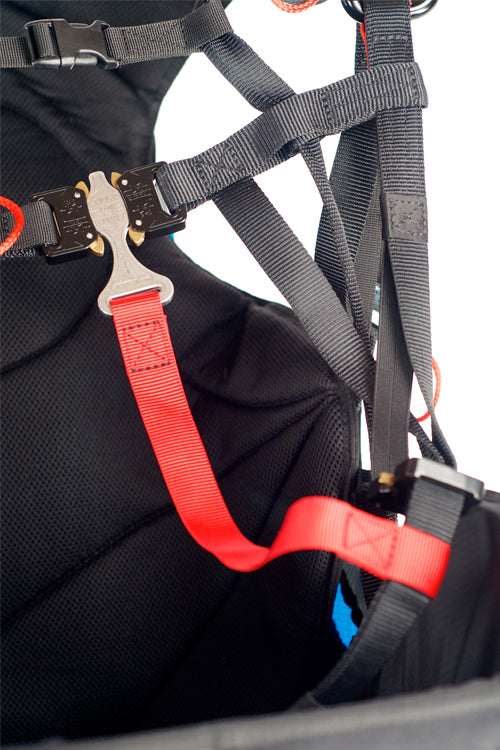
One common error is to try steering the glider with the A risers. This does not help at all. Always steer the glider by just using the C risers and walking sideways. The key to the technique is to take the time to build a good wall. A good trick to prepare the glider for launch is to move your C's hand left and right as far as possible each way. This will pull the tips of the glider under and help to keep them from rising too quickly during the inflation. It is only possible to use the C's to correct small turns, therefore if the glider goes a long way out of line the only way to sort it out is to collapse the glider back on the ground. It helps to be able to identify the risers easily, particularly the A and C risers. Most manufacturers mark the A risers, but to identify the C risers I put some red tape on the shackles of my glider. In Conclusion: I have seen many pilots crash as a result of ground handling and launching in strong winds. Some pilots seem to accept bad and dangerous take-offs and don't regard it as part of the flight. Well, I have seen as many injuries from launch problems as accidents
during flight, yet the crazy thing is that practicing launch technique
is easy as well as enjoyable, so why don't people do it. |
| Paragliding | Paramotoring | Hang Gliding | Clinics | Products | Weather | Stories | Used | Links | Activities |
|
Contact Us: (805) 965-3733 info@flyaboveall.com 2707 De La Vina Street Santa Barbara, CA 93105 Fly Above All, Inc. |