Ground Handling
a Body and Mind Approach
By Chad Bastian and Lee Anne Norris
Visualization is the process of creating a scene in the athlete's mind of what he wants to happen. While creating these scenarios, the athlete actually imagines every detail and the way it feels to perform the skill in just the manner he wants it to happen.
More and more athletes credit the practice of visualization with giving them a competitive edge. Scientific research shows us that visualization actually creates neural patterns in the brain, just as if the athlete had completed the physical action. It has been used widely to help with breakthroughs in stagnant performance as well as mastering novel skills.
In the next few pages, we will help you develop a method for using visualization to master one of the most challenging skills in paragliding – ground handling. These exercises are designed for the student that has had at least some instruction and is looking to improve their skills between lessons.
To get the most out of these ground handling visualizations, use all of your senses. Feel the risers in your hands and the pressure on your harness, hear the wind as it rustles the material of the glider, smell the grass in the field where you are practicing and look at the glider and observe its reactions to your input.
When you begin to use these visualizations, picture a perfect day and one-by-one work on each segment. In hands-on practice, these exercises are vastly easier if you have a steady (not gusty) wind of at least 6 mph, but not more than 12 mph. Therefore, begin by creating the perfect wind in your imagination. As your skills increase, imagine different wind conditions and use the visualizations to help you conquer these new challenges.
Building a Wall
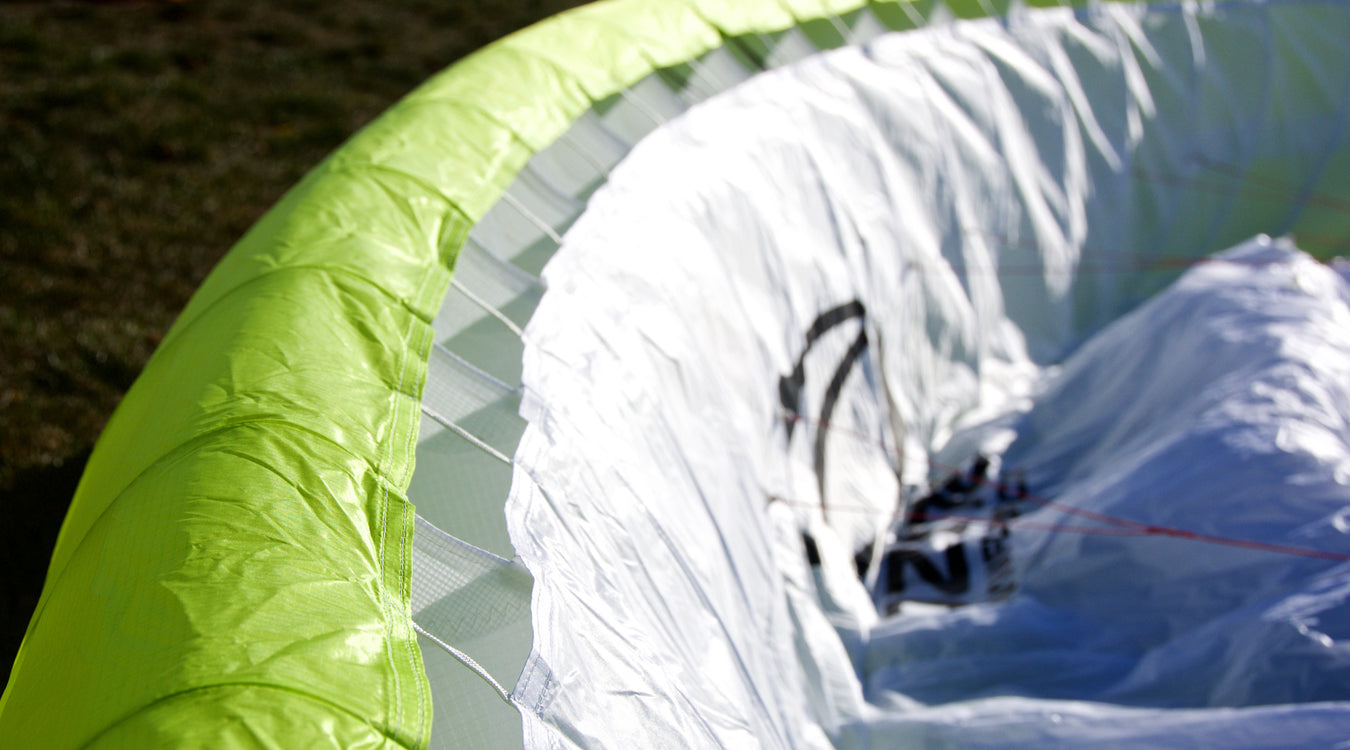
The goal when building a wall is to have every cell of the leading edge open and facing upwards to catch the wind. If one side or the other is folded over itself, or one wing does not have wind in it's cells, during inflation, the glider will immediately turn in that direction. Building a wall will allow you to make certain the lines should be clear. The canopy should be balanced and not off the wind line, leaning to one side or the other.
The Visualization
Lay out the glider and do a complete preflight check. Hook into the glider. Then take one entire riser set over your head while turning away and crossing under it. You will find yourself facing the glider with the risers crossed directly in front of you. Cross the risers close to your body. This will make it easier to see the risers you are looking for.
Take both of the rear risers (without the brake lines) in your left hand. Now gather the “A” risers (the accelerators) in your right hand. Make sure the ends of the risers and the beginning of the lines are even.
Extend your arms in front of you, holding the A risers directly over the rear risers. Step back to put a small amount of pressure against the glider. Raise your arms, using the “A” risers to lead the wing up to a point just off the ground. Then set it down again by relaxing the “A’s”, moving towards the glider and pulling your left hand and the rear risers back, past your left side.
Remember the rears are your decelerators. If at anytime you need the glider to stop moving, you can pull your left hand all the way back, past your left side, and the glider will come to the ground and be immobilized.
Brakes in Hand
The goal of having the brakes in the proper hand is to prepare you for flight. If you happened to get lifted off the ground in strong launch conditions, you will already have your brakes in your hands. You are therefore ready to control the glider without suddenly having to look for the brake toggles. Even if you don't get lifted up while reversed, when you turn to launch, your brakes are already in your hands, and you will be ready to exert control of the glider.
The Visualization
Once you have a good wall, you can get the proper brakes in your hands and bring the glider overhead for kiting. To make sure you have the correct brake in each hand, follow from the carabiner along the straight riser and take the brake with the hand that will use it. When done correctly, this will result in a clean "V" that is formed by the brakes going from your hands down to the brake pulley or guide, then back up the riser to the carabiner attached to your harness.
Trouble Shooting: It is possible for the carabiners to be twisted when you turn to kite in the reverse position. This is perhaps one of the most common places where new pilots make a mistake, resulting in a brake wrapped around a riser or even your arm and inhibiting control of the glider when you inflate and turn to face forward. So check your set-up carefully
The Reverse Inflation Using “A’s” and Rears
For use while launching free flight at thermic sites
The goal is to smoothly transition the glider from a wall position to a centered position in the air above the pilot’s head. This technique is vital for inflating safely in thermic conditions. It is highly likely that at some point a pilot will be inflating and perhaps kiting in strong thermic conditions. In these conditions it is not uncommon for the pilot to be dragged or worse yet, lifted into the air before they are ready. Should this occur, the only way to consistently and successfully immobilize the glider is to quickly and aggressively pull the kite down with the rears (or in some cases the “c” risers). We have personally observed tragedies where the pilot inflated the glider with only the A’s and was lifted off into uncontrolled flight. This can be avoided and to do so, this technique is vital.
The Visualization
Bring the wing overhead with the brakes in your hands, using the "A" and rear risers exactly as you did for building a wall, but continuing with the upward movement until the glider is above your head. When inflating, do not pull too hard on the "A" risers, but rather, use the harness as well as the risers to apply pressure to the wing, stepping backwards into the wind. Your inflation should be smooth and deliberate, bringing the glider overhead in 2-3 seconds.
Once overhead, the wing is now cutting through the air, supported by the lines and risers and there will be little wind resistance. When the glider is stabilized overhead using the "A" and rear risers, gently release the risers and make "contact" with the brake toggles. You are now ready to control the glider in the reverse position with the brakes in your proper hands.
Trouble shooting-
If you inflate the glider too slowly, the glider will "waddle around" at about 45 degrees and be difficult to control.
If you bring the wing up too quickly, it may over fly you and collapse. To avoid this, slow the glider when it reaches the flying position over your head, by applying a moment's pressure on the rear risers. Don't use enough brake to pull the glider back to the ground, just use a quick "pop" to keep it from over flying you.
When the glider is overhead, do not pull down on the "A" risers or you will cause a frontal collapse of the wing.
The Reverse Inflation Using Only the A’s and Proper Brakes
For use when launching a paramotor or at a strong, smooth, ridge soaring site
The goal is to smoothly transition the glider from a wall position to a centered position in the air above the pilot’s head. This technique is easier to learn than using “A’s” and Rear risers. It can also be very useful in strong smooth wind, where any pressure on the rear risers would keep the glider from reaching its apex. Also, this techniques is crucial when paramotoring as you do not have room in your hands for two sets of risers, brakes and the throttle. It is important to note however, that this technique makes it difficult to correct for a low wing. When using this technique you are also giving up the safety margin provided by having the rears in hand and ready to disable the glider. Brakes may be able to help you in this scenario, or they may cause you to be popped into the air or dragged back.
The Visualization
Look at the crossed risers in front of you. Gather the “A’s” extending from your left carabiner in your right hand. Gather the “A’s” extending from your right carabiner in your right hand. Observe that the risers are crossed, but your hands are not. Hold the risers just below the quick links. Square yourself into the glider and back up to you feel a light pressure on the “A’s”. Lean your harness back into the wind while using the “A’s” to guide the glider into the air. When the glider is almost to its balanced position in the air above you, release the “A’s” and be ready to give a quick tug on both of the brakes to keep the glider from over flying you.
Reverse Kiting With A’s and Proper Brakes
The goal is to maintain the glider in a perfectly balanced position in the air above your body, therefore preventing the glider from falling to the ground or pulling you off your desired path. A perfectly balanced glider is directly overhead, effortlessly flying with almost no brake input.
The Visualization
Visualize a "T" where the glider is the top of the "T" and the lines are the stem of the letter. This makes your position, the foot of the letter, balancing the "T" over your head.
While reversed, if the wing moves to your left, move to the left and simultaneously pull the left brake toggle to steer the glider back into balance. You will help the wing balance even more if you additionally seat steer the glider by facing the direction you are moving. This shortens the riser on the side you want to turn the wing towards, and sometimes this is all that is needed to balance the glider again.
SO, If the glider falls LEFT, face LEFT, step LEFT and add LEFT brake.
If the glider falls RIGHT, face RIGHT, step RIGHT and add RIGHT brake.
Love Your Low Wing!
Another way to think of this is to pay attention to the Low Wing. If the wing moves to the left, the top of the glider is lower on the left side. Give the lower, left side, the attention it needs by facing your body towards it, moving towards it and applying the brake on that side.
Trouble shooting – If the glider falls back as you are trying to correct it, that is because you are moving downwind and towards the glider. Do not walk downwind towards the glider. Never decrease the pressure you need to keep the kite flying. Rather, face your body and move laterally towards the low wing, always keeping pressure from the seat into the direction of the wind to keep the wing flying.
As you improve, your hands will become more sensitive to the feeling of light pressure of the wing. The sooner you recognize a change in the glider’s balance, the less input you will need to correct it. You become attuned to changes in the pressure and are ready to give a quick a "tug" to keep the wing balanced. (A "tug" is a swift, deep brake input returning to the balanced position to evaluate results. It is a movement straight down; don't reach across because you want the wing to go "that way".) A few quick "tugs" are sometimes better than holding the brake, since they allow the wing to continue flying rather than stalling it.
Forward Kiting
The goal is to use the reverse inflation to balance the wing overhead, then, when the glider is in control, smoothly turn forward, with the wing still balanced, fully prepared to ease the glider into a forward launch.
The Visualization
Look to the horizon as you turn around into the wind, feeling the 'seat to wind' pressure and keeping the wing overhead. Concentrate on feeling the glider. Develop your peripheral vision and pay attention to your risers. Notice when the risers shift out of balance. Also, feel the pull of your glider going out of balance, pressuring you to move to that side. Without looking at your wing, correct the balance by moving toward the shifting riser. Balance the kite by moving towards the pull, but braking away from the pull.
Concentrate on the horizon. Feel the wind coming and actively feel the balance of the kite. It's like 'dancing' with your glider. If it moves to one side, dance with it a bit, but use brake input to lead your partner back where you want them to go.
Practice turning back to the reverse kiting position as well. This comes in handy if the glider begins to fall back. By learning to quickly turn back to the reverse kiting position you are prepared to lean back in the seat into the wind and balance the wing overhead. You will tend to keep your hands higher in this position, pulling less brake and allowing the wing to come back overhead. If the glider does continue falling, you can walk forward toward the glider instead of being pulled backwards.
Troubleshooting - Do not look at the wing when you turn from reverse to forward kiting or when you are in the forward kiting position. Doing so may cause you to become disoriented or your body english may give unintended input to the wing.
If you feel the wing falling back, act quickly! Turn back to the reverse position and take control of your glider immediately! Letting the wing fall behind you while facing forward in wind can be dangerous because most people have a tendency to lower their hands when this occurs. This in turn applies the brakes and increase the backwards pull on the pilot. The result is that you will likely land on your rear and get dragged.
Make the Time for Visualization
Visualizing these exercises for five to ten minutes a day can lead to a dramatically improved response time and better kiting control when you have the opportunity to do a hands-on practice session. Why? Because when the time comes to kite in the real world, you will not have time to think through each proper response. By visualizing the process you will create the neural pathways that support kiting, allowing you to react more quickly when you kite in reality.
|