Common Beginner Mistakes in Competition
Josh Cohn josh_cohn@hotmail.com
2000/12/19.
While this laundry list of pitfalls is aimed at competitors, many
will also apply to cross country flying. If you are really creative, you
may even figure out how to apply some to setting the clock on your VCR.
In an attempt at organization, the mistakes are grouped under judgment,
flying skills, and mindset.
Judgment
A snap decision
Bad decisions are often made in a rush or without conscious thought.
So think ahead and plan the next move before topping out a thermal. While
gliding to what you think will be the next lift, have a plan B in case
it's not there.
Launch timing
The usual mistake is waiting too long, until the wind has picked up and
the lead gaggle is specked out. I like to figure the time it will take
to get geared up, launch, and top out the lift before the start tarp opens.
Some pilots find extra time waiting for a start tarp relaxing, while others
would rather wait on the ground. I once watched Tomas Suchanek repeatedly
climb through the gaggle to the top, fly out and spin back down before
the start tarp at the '95 US HG Nationals.
Flying too fast or too slow
You have to be prepared to shift gears, perhaps several times in a flight.
Flying fast is not so much about stepping on the speed bar all the time
as being discriminating about which lift one circles in. Sometimes the
winner is the one who first realizes that it is possible to glide straight
to goal. Then again sometimes the one who flies conservatively and stays
up is the only one to make it. It's a matter of reading the area and the
day's conditions.
Pushing it too far gliding in to goal
Paragliders are more prone to deflations at higher speeds, with more
loss of altitude and time spent recovering to be expected. It is tempting
to come charging in to goal at full speed, but unless the air is smooth
and one is high, it's not a great idea.
How worthwhile it is to take a risk of being slowed down by a deflation
depends on the scoring system. If there are place points, it may be worth
taking a little risk to get there before another pilot. But if there are
not, beating someone by less than ten seconds usually only gets you a
few points. On the flip side of this, I heard about one meet where Kari
Eisenhut and Steve Cox, two of the top Swiss pilots were gliding in together
to goal. Steve got a deflation and lost a few seconds. Kari, like the
good guy he is, waited for Steve and they crossed goal together. Kari
learned a lesson when Steve ended up winning the meet three points ahead
of him.
Descending at cloudbase
When a gaggle gets to cloudbase, the pilots glide out on course, pulling
ears in as needed to avoid getting sucked up. Getting sucked into a cloud
is generally a result of poor planning. But it does occasionally happen.
The most dangerous thing in this situation is to spiral or b-line down
toward an unsuspecting gaggle of pilots below. It is safer to take a GPS
heading toward the closest edge of the cloud and hold the heading, though
this is easier said than done. Upon popping out, fairness demands a descent
back down to cloud base before continuing on. Of course it is best to
stay away from the middle of a sucking cloud and avoid the whole issue.
Flying Skills
Gaggle etiquette
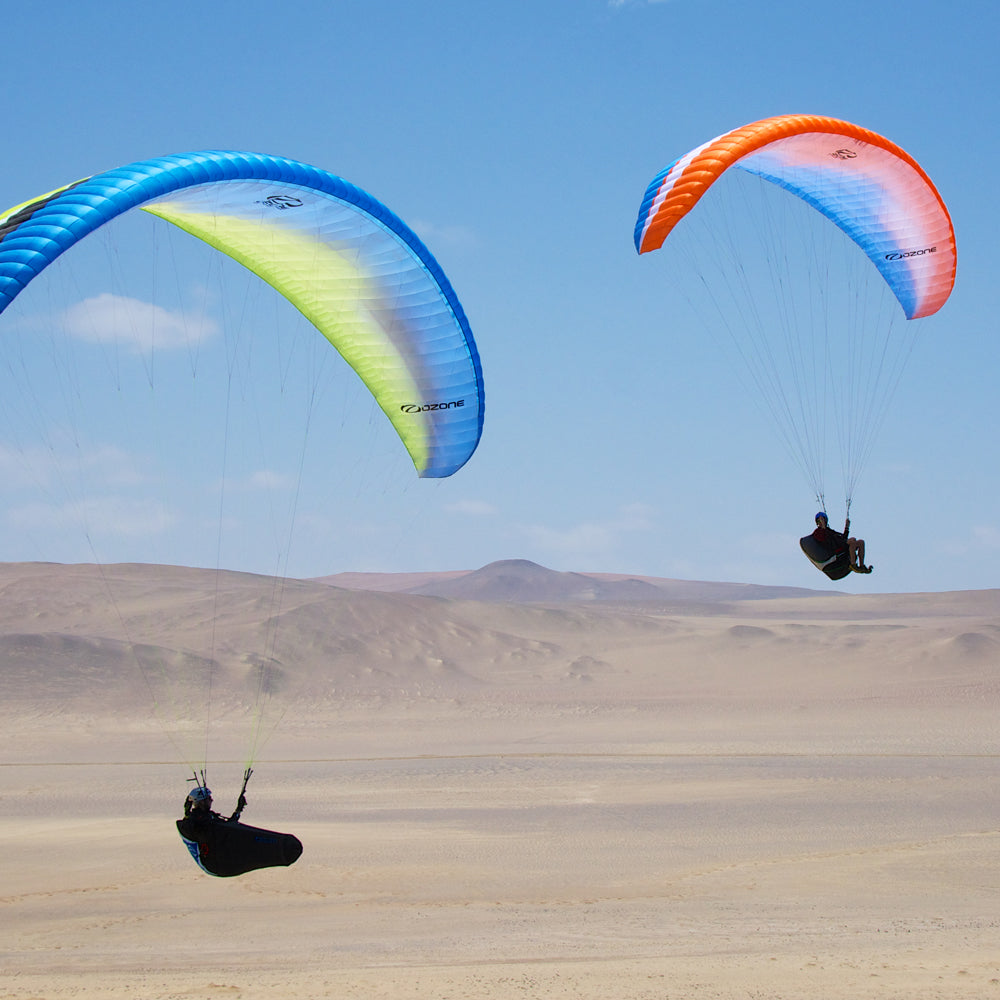
Competition gaggle flying is like urban driving. It may seem crazy to
those not used to it. But along with the increased closeness and aggressiveness,
there is a high level of attention being paid. Most of the top pilots
realize that they will climb best if they do not get in each other's way,
and that it's very hard to make goal while tangled up in a midair.
I assume you know the basic thermalling right-of-way rules: right of
way goes to the glider in the thermal first and the one climbing up from
below. But there are some finer points of thermalling etiquette. Given
the above, it follows that when joining pilots in a thermal, you should
slow down, speed up, or turn wider to yield the right-of-way. In rough
air, flying directly above someone else is risking a midair, besides which
they may not see you. My most common comment in thermal clinics and flying
with newer comp pilots is "turn tighter". This can of course
be taken to an extreme. Nevertheless, it is mildly annoying to get stuck
behind someone turning wide circles. It is not necessarily rude to turn
inside someone in this situation. If it is done right, so as not to push
the other pilot out of the thermal, there is no problem.
Several times I've flown with apparently self-taught paraglider pilots
with experience in other soaring aircraft. They tend to know what and
where the thermal is very well, but may be lacking in the glider control
department. It is especially tricky trying to out-climb someone who is
pitching and rolling wildly, on the edge of deflations, but miraculously
going up pretty well. While keeping the glider stable overhead may not
be the only way to go up, it is certainly safer and more considerate.
This is probably a more rare phenomenon as the importance of professional
paragliding instruction has become increasingly clear.
While pushiness may occasionally be effective, it does not go unnoticed.
When the leaders strike out in front, they take a risk (of finishing slower
or sinking out) in return for the chance to win. But that risk is greatly
reduced if two or three go together. Are you more likely to gaggle with
the pilot you enjoy flying with, or the rude one?
A trick for dealing with being cut off is to aim my glider at the trailing
edge of the other glider that is on a right angle closing course with
me. This is the flip side of "leading" a moving object to hit
it: "Trail" it to miss it.
Flying alone
While flying alone is excellent practice for being in the lead, there
is usually no advantage to it unless one is in the lead. It's hard to
beat a good fast gaggle.
Following
Following is excellent practice at first, but must be outgrown at some
stage to progress. If you blindly follow, you will eventually either get
left behind or stuck in "gaggle drag" with a slow, overly conservative
gaggle. Also, should you find yourself in the lead, you may be at a loss
for what to do. Chronic following can be seen as rude. Then again, if
someone is following you and keeping up, you are probably flying too slowly.
It can be comforting to be high above a group of pilots groveling low.
If they find something and get up, you are sure to be able to use it.
However, if you divert course from a distance to glide over them and they
are still below you when you get there, you may very well be groveling
or landing with them.
It's usually best to avoid the temptation to hop back and forth between
neighboring cores. You usually lose height doing this, unless you have
switched to one rising significantly faster. In addition, the other core
will often come to you if you are patient. This can create difficulties
if there are two gaggles turning opposite directions.
A glider too hot
While prototypes these days do outperform serial gliders, the benefits
only become apparent at speeds over 1/3 speed bar, and are probably less
than 10% there. If you are too scared to push the speed bar on a comp
glider (or a DHV 2-3, or whatever), then you lose all of the advantage
and then some.
Mindset
Negative attitude
I have sat on launch with another pilot before and talked each other
out of flying the day's task, even though it turned out to be ok. A few
hours of wind, or a few days of rain can get people into a "this
sucks" mindset, which makes good performance unlikely.
Say you have a terrible day on the first task of a meet (see my experiences
at the Europeans, October's column). Do you take it as evidence that you'll
never be any good, or as an opportunity to practice flying faster, since
you've got nothing to lose?
Nerves
This goes away somewhat with time. But then find yourself leading a meet
for several days for the first time and it comes right back. Avoiding
stimulants before flight may be a good idea: save the energy drinks for
the party later.